Your Talend jobs.
Running on
modern infrastructure.
Talend's licensing has changed — and the window to migrate on your own terms is open now. Our Talend importer, soon to be open source, converts your jobs, joblets, contexts and connections into native Apache Hop pipelines and workflows, and tells you exactly which components need a person. Our engineers take it from there. You get a scoped engagement with a real timeline, not a blank estimate.

The same job, in Talend and in Hop
Order lines get their order, product and brand, a line total, and land in another database. In Talend that's one tMap with three lookups; in Hop the importer lays the same steps out one by one.
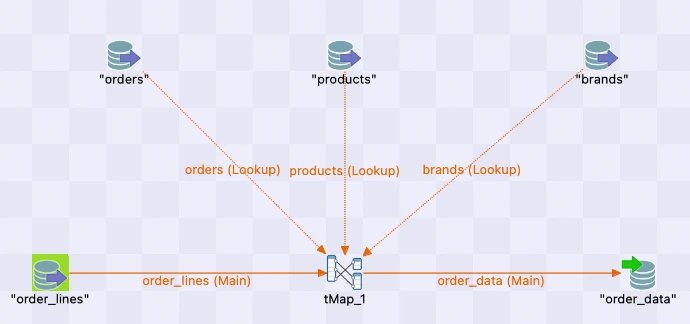
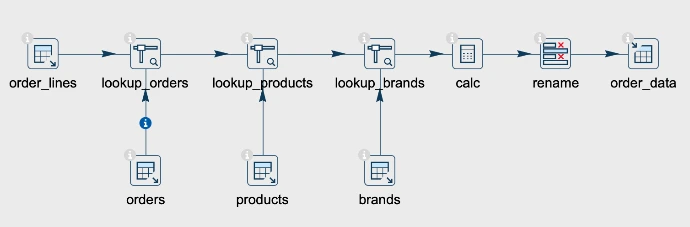
quantity × price.// Job from Packt's Getting Started with Talend Open Studio examples (MIT) · converted with the Talend importer (preview) · transforms renamed and laid out in Hop for readability
What the importer handles — and what our team takes over
The importer sorts every component in your project into one of three groups. These are the same three groups you'll see in the migration report for your own jobs.
// Nothing is dropped silently. A component without a Hop equivalent becomes a placeholder, so the pipeline keeps its shape — and the report says why.
Why we won't quote you a conversion rate
The same importer gives very different results on different projects, and a single percentage hides that. Your project will have its own figure, and the report will show it.
Talend to Hop — how each component translates
Most Talend components have a counterpart in Apache Hop, and the importer converts the common ones. Some need finishing by hand. A few have no Hop equivalent. For those, the importer puts a placeholder in the pipeline, with the component's name and connections but not its settings, and the report lists it. That part is then rebuilt, either from other Hop transforms or by developing it (the components marked Scoped below).
| Talend component | Apache Hop equivalent | Migration path |
|---|---|---|
| tMap | Stream Lookup or Merge Join, Calculator, Filter Rows and Select Values — joins, rejects and multiple outputs preserved | Automatic |
| tFilterRow | Filter Rows | Automatic |
| tAggregateRow / tAggregateSortedRow | Memory Group By | Automatic |
| tJoin | Merge Join | Automatic |
| tNormalize / tDenormalize | Split Fields to Rows / Memory Group By (tDenormalize needs a merge column) | Automatic |
| t |
Table Input / Table Output on a shared, named Hop connection — across the common database vendors and generic JDBC | Automatic |
| t |
Execute SQL | Automatic |
| tConvertType | Select Values (metadata tab) | Automatic |
| tLogRow | Write to Log | Automatic |
| tAdvancedFileOutputXML | Advanced XML Output | Automatic |
| tRunJob | Pipeline Executor, pointing at the child's newest version | Automatic |
| tCreateTable | SQL action in a control-flow workflow | Automatic |
| t |
Call DB Procedure — arguments typed from the schema | Review |
| tJavaRow / tJava | User Defined Java Class — common idioms translated, and always flagged so someone checks the result | Review |
| tAssert | Java Filter, failing rows to Write to Log | Automatic |
| tJava / tJavaFlex, untranslated parts | User Defined Java Class — code the importer can't translate, and tJavaFlex start / end code, kept as comments and ported by hand | Manual |
| tSOAP | Web Services Lookup | Manual |
| tOracleBulkExec | Oracle Bulk Loader | Manual |
| tPivotToColumnsDelimited | Denormalize Rows | Manual |
| tESBProviderRequest | Custom development required | Scoped |
| tStatCatcher | Output Steps Metrics (port from PDI) | Scoped |
| SAP components | SAP SNC integration — developed with know.bi | Scoped |
Send us an export, get your conversion report.
Share a Talend project export and we'll run it through the importer. You get the migration report for your own jobs: what converts, what's flagged and why, and what needs a person. You see all of it before you commit to anything. The audit is free and takes a few days.
What every conversion gives you
The importer produces a Hop project you can open, run and deploy, not just a folder of files. The importer is about to be released as open source (Apache 2.0) through the Apache Hop marketplace, so you'll be able to run it yourself at any time.
What your team keeps
Apache Hop and Talend share the same transformation model at their core. Your team's data engineering knowledge transfers — the platform changes, the expertise doesn't.
A typical Talend migration
Talend migrations need more manual work than PDI, mostly because of embedded Java. The process is the same: audit first, scope second, deliver third.
Migrate before Talend decides for you
The licensing window is open now. Share your project with us and we'll come back with the conversion report and a realistic breakdown: what converts, what our team handles, and what it costs.
Your Talend jobs.
Running on
modern infrastructure.
Talend's licensing has changed — and the window to migrate on your own terms is open now. Our Talend importer, soon to be open source, converts your jobs, joblets, contexts and connections into native Apache Hop pipelines and workflows, and tells you exactly which components need a person. Our engineers take it from there. You get a scoped engagement with a real timeline, not a blank estimate.
The same job, in Talend and in Hop
Order lines get their order, product and brand, a line total, and land in another database. In Talend that's one tMap with three lookups; in Hop the importer lays the same steps out one by one.
quantity × price.// Job from Packt's Getting Started with Talend Open Studio examples (MIT) · converted with the Talend importer (preview) · transforms renamed and laid out in Hop for readability
What the importer handles — and what our team takes over
The importer sorts every component in your project into one of three groups. These are the same three groups you'll see in the migration report for your own jobs.
// Nothing is dropped silently. A component without a Hop equivalent becomes a placeholder, so the pipeline keeps its shape — and the report says why.
Why we won't quote you a conversion rate
The same importer gives very different results on different projects, and a single percentage hides that. Your project will have its own figure, and the report will show it.
Talend to Hop — how each component translates
Most Talend components have a counterpart in Apache Hop, and the importer converts the common ones. Some need finishing by hand. A few have no Hop equivalent. For those, the importer puts a placeholder in the pipeline, with the component's name and connections but not its settings, and the report lists it. That part is then rebuilt, either from other Hop transforms or by developing it (the components marked Scoped below).
| Talend component | Apache Hop equivalent | Migration path |
|---|---|---|
| tMap | Stream Lookup or Merge Join, Calculator, Filter Rows and Select Values — joins, rejects and multiple outputs preserved | Automatic |
| tFilterRow | Filter Rows | Automatic |
| tAggregateRow / tAggregateSortedRow | Memory Group By | Automatic |
| tJoin | Merge Join | Automatic |
| tNormalize / tDenormalize | Split Fields to Rows / Memory Group By (tDenormalize needs a merge column) | Automatic |
| t |
Table Input / Table Output on a shared, named Hop connection — across the common database vendors and generic JDBC | Automatic |
| t |
Execute SQL | Automatic |
| tConvertType | Select Values (metadata tab) | Automatic |
| tLogRow | Write to Log | Automatic |
| tAdvancedFileOutputXML | Advanced XML Output | Automatic |
| tRunJob | Pipeline Executor, pointing at the child's newest version | Automatic |
| tCreateTable | SQL action in a control-flow workflow | Automatic |
| t |
Call DB Procedure — arguments typed from the schema | Review |
| tJavaRow / tJava | User Defined Java Class — common idioms translated, and always flagged so someone checks the result | Review |
| tAssert | Java Filter, failing rows to Write to Log | Automatic |
| tJava / tJavaFlex, untranslated parts | User Defined Java Class — code the importer can't translate, and tJavaFlex start / end code, kept as comments and ported by hand | Manual |
| tSOAP | Web Services Lookup | Manual |
| tOracleBulkExec | Oracle Bulk Loader | Manual |
| tPivotToColumnsDelimited | Denormalize Rows | Manual |
| tESBProviderRequest | Custom development required | Scoped |
| tStatCatcher | Output Steps Metrics (port from PDI) | Scoped |
| SAP components | SAP SNC integration — developed with know.bi | Scoped |
Send us an export, get your conversion report.
Share a Talend project export and we'll run it through the importer. You get the migration report for your own jobs: what converts, what's flagged and why, and what needs a person. You see all of it before you commit to anything. The audit is free and takes a few days.
What every conversion gives you
The importer produces a Hop project you can open, run and deploy, not just a folder of files. The importer is about to be released as open source (Apache 2.0) through the Apache Hop marketplace, so you'll be able to run it yourself at any time.
What your team keeps
Apache Hop and Talend share the same transformation model at their core. Your team's data engineering knowledge transfers — the platform changes, the expertise doesn't.
A typical Talend migration
Talend migrations need more manual work than PDI, mostly because of embedded Java. The process is the same: audit first, scope second, deliver third.
Migrate before Talend decides for you
The licensing window is open now. Share your project with us and we'll come back with the conversion report and a realistic breakdown: what converts, what our team handles, and what it costs.