
We just shipped something we're genuinely proud of.
With the release of Apache Hop 2.18, the Putki.io team contributed native WebDAV VFS support to the project — complete with its own metadata type. If you work with NextCloud in your data pipelines, this one's for you.
But strategically choosing a storage platform is only half the battle; integrating it seamlessly into your data orchestrations is where the actual value is unlocked.
Today, we are thrilled to talk about a major milestone that achieves exactly that. With the freshly minted Apache Hop 2.18.0 release, the Putki team has officially contributed a native WebDAV VFS (Virtual File System) with its own metadata type to the Apache Hop project.
Here is a high-level look at how this architectural upgrade works and why it makes integrating with files in NextCloud an absolute breeze.
The problem: The high cost of storage silos
In typical data integration pipelines, connecting to collaborative storage layers like NextCloud usually requires jumping through several engineering hoops. You either have to map local network drives across your execution servers, deal with temporary file downloads via custom REST API calls, or handle hardcoded credentials across multiple pipeline transforms.
These workarounds introduce operational risk, technical debt, and architectural complexity. They slow down time-to-market for new data initiatives and make maintenance an ongoing headache.
The solution: Apache Hop’s VFS architecture meets WebDAV
Apache Hop is inherently metadata-driven. One of its greatest architectural superpowers is the Virtual File System (VFS). VFS allows Hop to treat diverse data layers —whether local disks, AWS S3, Google Cloud Storage, or Azure Blob— identically through simple URI protocols.
By introducing native WebDAV VFS support with its own dedicated metadata type, we’ve brought that exact same "design once, run anywhere" abstraction to NextCloud.
How it works architecturally
Instead of constructing complex HTTP requests or managing external synchronization clients, the WebDAV Connection metadata type abstracts the entire protocol away.
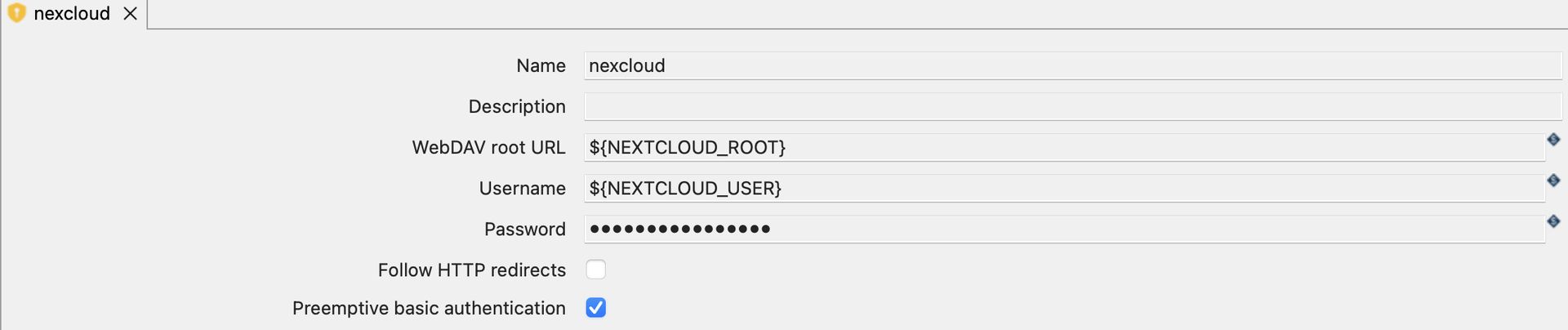
Centralized Connection Management: You define a new WebDAV connection in your Hop metadata, specifying your NextCloud server's WebDAV URL, username, and securely encrypted password.
Dynamic Protocol Creation: Just like Hop’s other VFS types, the Name you give this metadata item instantly becomes a recognized protocol scheme within your project.
Seamless URI Referencing: If you name your connection nextcloud, you can immediately read from or write to your NextCloud instance anywhere in Hop using a clean, native URL:
nextcloud://<PATH>/sales_forecast_2026.xls
With this metadata item in place, Apache Hop and Putki data engineers can now browse and access and work with all of the files on their NextCloud instance just like every other VFS file.
What actually changes for your team
From a high-level architectural and business perspective, this simple protocol abstraction unlocks massive efficiency gains:
1. Zero friction data ingestion & distribution
Business users love NextCloud for managing spreadsheets, operational CSVs, and collaborative documents. Now, data engineers can ingest files the second a business unit uploads them, or dump processed analytical outputs directly back into a shared NextCloud folder. No middle layers, no staging areas, and no manual downloads.
2. Security and decoupling
Because credentials and root server endpoints are safely tucked into Hop's metadata management system, they are never hardcoded into your actual pipeline configurations. Environments are perfectly decoupled. You can easily switch your nextcloud:// protocol from pointing to a local development sandbox to a secure production cluster using Hop environment variables.
3. Sovereign European technology stacks
For enterprises looking to maintain compliance, enforce GDPR strictly, and minimize reliance on non-European hyperscalers, the NextCloud + Apache Hop combination provides an enterprise-ready, completely open-source alternative. This contribution ensures that choosing a sovereign tech stack doesn’t mean compromising on robust, automated data engineering capabilities.
Driving business outcomes through open source
At Putki.io, we are builders. Contributing this feature to Apache Hop 2.18.0 wasn't just about solving our own data synchronization needs; it was about expanding the open-source ecosystem to natively value platform flexibility.
We built this because we needed it. Turns out, connecting NextCloud to a production data pipeline was harder than it should be — so we fixed it the right way and contributed it back. If you're dealing with the same problem, you don't have to anymore.
To complement native WebDAV support, we also added ODS (OpenDocument Spreadsheet) as an output format to the Excel Writer transform. NextCloud users typically work in LibreOffice and OpenOffice environments where ODS is the native spreadsheet format. With this addition, pipelines can now write processed data directly to .ods files and push them to NextCloud via WebDAV, keeping the entire workflow inside Hop, and keeping the output format compatible with how your team actually works.
Ready to try it? Download Apache Hop 2.18, configure your first WebDAV connection, and experience NextCloud orchestration firsthand.
If you want to talk about modern, sovereign data architectures — or just want to geek out about open-source data stacks — reach out to us at Putki.io. We'd love to hear from you.