
stack without a line of code.
Sovereignty vs. velocity
The sales team updated 200 customer contacts in Nextcloud over the weekend. Zero of them made it to Odoo's CRM. Now your largest client is on the phone asking why their order shows pricing from six months ago. You have no answer.
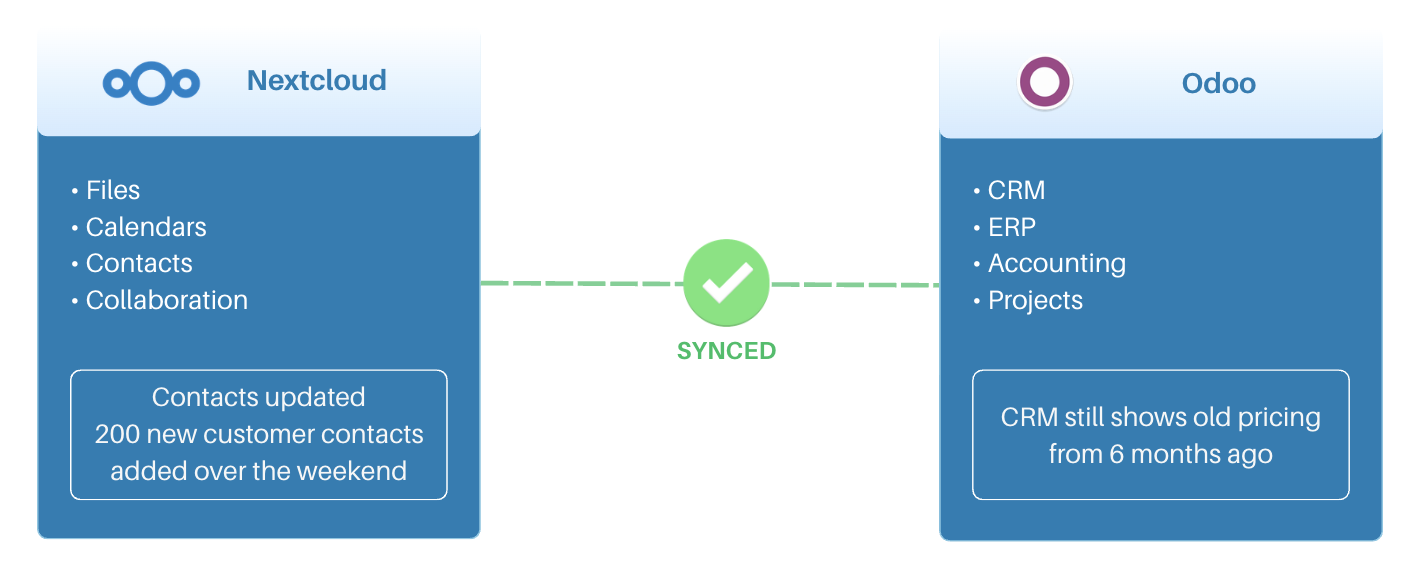
This is what digital sovereignty actually looks like in the real world. You've got Nextcloud. You've got Odoo. You've got your data locked safely inside Europe. But they don't talk to each other. So you're stuck writing custom Python scripts to sync data, or you're hiring someone full-time just to manage manual integrations.
Either way, you're paying for sovereignty with velocity.
So you're stuck syncing data manually
Here's what happens when you commit to open-source and European infrastructure:
Your sales team updates contacts in Nextcloud. Your finance team works in Odoo. Your project manager creates milestones in Odoo. But the team calendar in Nextcloud never gets the update. So when a client asks "when's the deadline?", nobody knows if they're looking at Odoo or Nextcloud. You've built a company where different departments are working with different versions of the truth.
When you try to fix this, the options are bad. You can hire a contractor to write custom integration code—which works until Nextcloud or Odoo updates their API, and suddenly your integration breaks. Or you can accept that your systems don't talk to each other, and your team spends hours manually syncing data that should sync automatically.
And if you're an auditor? Forget it. You have no visibility into how data flows between systems, because there's no pipeline. Just scripts. Just prayers that nothing broke.
The integration problem nobody solved
The culprit isn't Nextcloud or Odoo. Both are solid tools. The problem is that the open-source world was built around individual applications, not integration.
For years, if you wanted your systems to talk to each other, you either:
- Paid a vendor (hello, cloud lock-in)
- Wrote code yourself (hello, technical debt)
- Accepted it as the cost of sovereignty
Nobody thought about what a data engineer in Europe needed: a way to visually build data pipelines that connect Nextcloud to Odoo without writing a single line of code.
Until now.
Now your Nextcloud and Odoo actually talk
Instead of asking you to write integration code, we went upstream to Apache Hop and added native support for WebDAV (file access), CalDAV (calendars), and CardDAV (contacts).
This means you can now build visual pipelines that read from and write to Nextcloud the same way you'd read from any database. Drop a transform in the canvas, configure it, and your data flows automatically.
No Python scripts. No API wizardry. Just metadata-driven pipelines that do what you tell them to.
Contact sync. Document workflows. Real calendars.
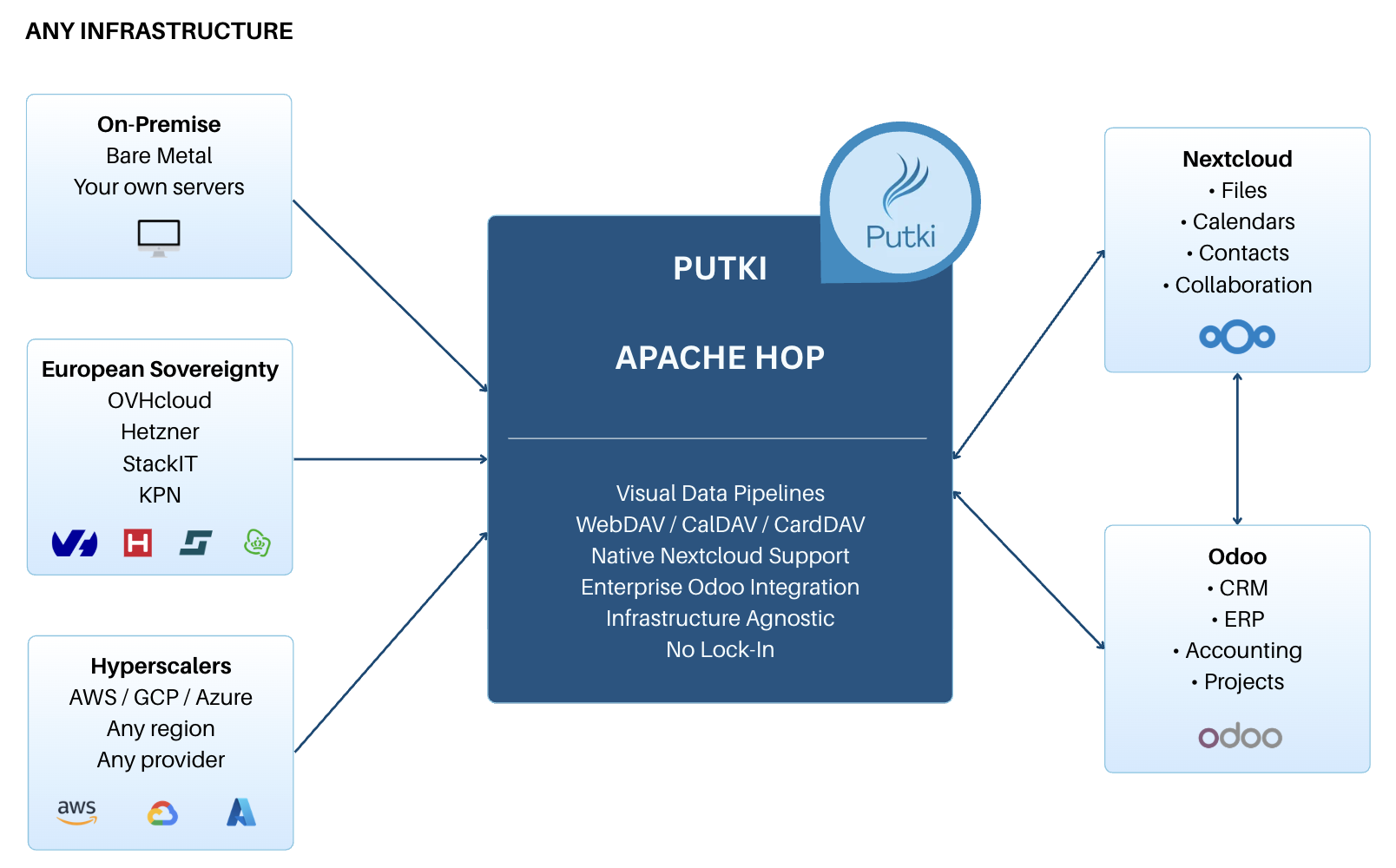
Contact data stays in sync. Your sales team updates a customer contact in Nextcloud. A Hop pipeline reads it, standardizes the format, and pushes it into Odoo's CRM. No manual steps. No version conflicts. One source of truth.
Document workflows automate. Invoices arrive in a secure Nextcloud folder. A pipeline grabs them, extracts the data, and pushes them into Odoo's accounting module. Processing that used to take a clerk four hours now happens in minutes. And you have a complete audit trail.
Team calendars actually reflect reality. Project milestones created in Odoo get pushed automatically into your Nextcloud Calendar. Everyone sees the same deadlines. No more "I didn't know that was this week" conversations.
Your infrastructure stays yours. Whether you run on OVHcloud, Hetzner, your own servers, or a mix—the pipelines work identically. You're not locked into a vendor. You're not locked into a cloud provider. You're locked into nothing except your own infrastructure.
Sovereignty doesn't have to mean slower
Building sovereign infrastructure usually means accepting slowness. Longer deployment times. Fewer integrations. Less automation.
With Hop and Nextcloud support native to the orchestrator, you get none of that. You get the same flexibility and speed as any cloud-first platform, except the data stays in your jurisdiction and under your control.
That's not a compromise. That's a different path entirely.
Ready to stop manual syncing?
If you're running Nextcloud and Odoo today, and you've been stuck manually syncing data between them, there's another way.
Contact the Putki team and we'll show you exactly how to build those pipelines. You'll see in 30 minutes what you can automate that you thought required custom development.
Because digital sovereignty shouldn't mean slower business processes. It just means ownership.